
Oakland Planning discusses federal judge’s ruling on their political sign ordinance
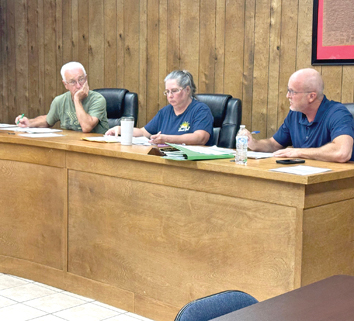
Pictured (l-r): planning commission members Jack Poole, Marilyn Austin, and city planner Ed Courton at the meeting.
By: Carolyn G. Rhea,
Staff Writer
The Oakland Planning Commission met on Tuesday, August 5. Present were Vice-Chairman Christina Hall and members Mike LaBudde, Gary Schmidt, Mayor Adrian Wiggins, Jack Poole, Alderman Marilyn Austin, city planner Ed Courton, and city attorney Tom Minor. Absent was Chairman Stephen Laskoski.
ASI Oakland is requesting preliminary plat approval to subdivide approximately 7.70 acres into two parcels with one being 0.82 and the other 6.88 acres. The property is located on Highway 64 next to Kroger and the future Chick-Fil-A. Planner Ed Courton said the owner is planning to sell the small piece on the southeast corner to a developer and has to go through this process to break it off. The remainder will remain as Lot two and as they move forward hopefully with Chick-A-Fila in the next couple of months to a year, they will come back and replat that again. The commission voted their approval.
Sign Ordinance
The commission held discussion on signs. Attorney Tom Minor stated he, Courton, and Mayor Wiggins have been in discussion on where we are on the political sign ordinance. This is in regards of what they need to do since the lawsuit filed by former Alderman Jeff Fisher last year and the court order entered by the federal court as a result of that lawsuit. He said that order made void Oakland’s town ordinance dealing with campaign signs. It struck down the sentence in the ordinance that says “signs may be erected no earlier than 90 days prior to an election and shall be removed within seven days following an election.”
Minor has reviewed the sign ordinances of several municipalities close by and he thinks the Arlington sign ordinance is more adaptable on this issue. Their ordinance takes everything dealing with political signs and incorporates it and weaves it into the entire fabric of the sign ordinance. Arlington’s ordinance refers to political signs as “political preference signs.” Mayor Wiggins has questioned the difference between campaign signs and political preference signs and Minor has reached out to MTAS. He has not received a clear answer yet.
Minor suggested to the commission to adopt a new set of sign ordinances and incorporate Arlington’s political sign provisions and it goes to the mayor and board of aldermen for final approval. He said right now the town is permanently enjoined by the court order from allowing the town to put time period constrictions on when these political signs can be put up anyway.
Wiggins said right now we have no political sign ordinance. Starting at the end of December you can pull a petition to run for the next election and when qualified, there is no provision on who can put out signs and when. You could put your sign out at the end of December. We need to deal with this ordinance rather quickly. He said I see a problem with Arlington weaving this all through the sign ordinance. Minor pointed out that Arlington’s ordinance says no time restriction which would be compliant with the law.
Wiggins questioned whether the planning commission has any authority on this other than regulating commercial business. Minor stated no ordinance can be adopted by a planning commission. Ed Courton quoted from state statute that no zoning amendment can be considered until approved by a planning commission. They have all the right by state law over the entire zoning code. They are the recommending body and the city board approves it.
Christina Hall asked is the state law saying that we cannot put a time limit on political signs. Minor replied that is what a federal judge currently says and a federal court overrides anything a state court says. Now we have a state statute that says political signs can be restricted to 60 days before the date of first day of early voting. However that statute is in direct conflict with the first amendment of the Constitution which is what the federal court based its ruling on. He has reached out to the state attorney general’s office for an explanation on the obvious conflict between state statue and United States first amendment. I believe we will get an AG opinion to resolve this.
Wiggins clarified that Oakland did not lose a case in court, we came to an agreement to settle the case and that was to remove that one line from our code.
After more discussion, it was decided to wait until they get a ruling from the attorney general’s office before making any recommendations on the sign ordinance. Courton said he will work with the Arlington ordinance and changes to suggest in their sign ordinance to bring next month for review.